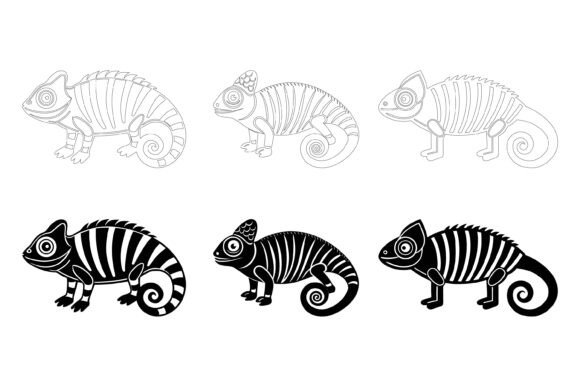
Understanding Chameleon Lizards and Choosing the Right Digital Illustrations for Your Projects
Chameleon lizards have fascinated naturalists, designers, and storytellers for generations. Their ability to shift colors, their independently moving eyes, and their deliberate, almost prehistoric movements make them a subject of continuous interest across biology, art, and commercial design. Whether you are building educational content, designing a brand identity, or creating infographics that rely on visual metaphor, chameleon imagery often communicates adaptability, observation, and transformation. This article explores what makes chameleon lizards distinct as a subject and examines how digital illustration collections can serve different creative needs without overspending or settling for the wrong format.
What Sets Chameleon Lizards Apart as a Visual Subject
Chameleons belong to a family of reptiles with roughly 200 known species, most of which inhabit Madagascar and parts of mainland Africa, though some range into southern Europe and Asia. Their physical traits create a unique visual profile that illustrators and photographers approach in different ways. The independently rotating eyes give chameleons a panoramic field of view and create an expressive, almost otherworldly appearance. The zygodactyl feet, structured like gripping clamps, and the prehensile tail suited for branch stability add to their distinctive silhouette.
Color change in chameleons is not purely camouflage as popular culture often suggests. It also reflects temperature regulation, mood signaling, and social communication. This nuanced behavior means that a single static image rarely captures the full story. For designers and educators, this creates both a challenge and an opportunity. A well-executed illustration can emphasize specific traits, highlight anatomical features, or stylize the lizard to support a metaphor without the unpredictability of live photography.
Why Vector Illustrations Matter for Chameleon Imagery
When sourcing chameleon artwork, the file format strongly influences what you can do with the image later. Raster images such as JPEGs or PNGs are composed of fixed pixels. They work well for final placement in a blog post or presentation slide, but they lose quality when scaled and offer limited editing flexibility once flattened. Vector formats, including AI and EPS, store the illustration as mathematical paths. This means a chameleon illustration can be resized from a small app icon to a large trade show banner without any degradation in sharpness.
Vector files also let you access individual elements within the artwork if the illustration has been built with an organized layer structure. You might want to isolate the chameleon's eye for a close-up detail, repurpose the tail curve as a standalone design element, or change the green tones to a warmer palette that matches your brand. Access to well-named layers and logical grouping makes these edits predictable rather than frustrating. For anyone who has spent hours trying to select and modify a flattened raster graphic, the difference is substantial.
Comparing Formats for Different Use Cases
The choice between AI, EPS, JPEG, and other formats depends largely on where the chameleon image will appear and how much control you need. Below are some practical comparisons to guide the evaluation process.
Print Projects
For printed materials such as brochures, posters, educational handouts, or product packaging, vector formats like AI and EPS are typically the preferred choice. They preserve sharp edges at any resolution and separate cleanly from backgrounds when set up for professional printing. A chameleon illustration saved as a high-resolution JPEG can work for smaller print sizes, but it may show pixelation or compression artifacts when enlarged. If your project includes multiple print sizes or requires spot color adjustments, a well-structured vector file saves significant time and expense.
Web and Digital Platforms
Websites, apps, and interactive infographics benefit from images that load quickly and scale across device screens. While vector files are often converted to SVG or optimized PNG for web delivery, starting from an AI or EPS source gives you the flexibility to export exactly the resolution and crop you need. A chameleon icon for a mobile app, for instance, requires crisp edges at small sizes. Re-exporting from a vector master file means you can create versions at 16x16 pixels for favicons and 512x512 pixels for app store listings from the same artwork.
Infographics and Data Visualization
Chameleons appear frequently in infographics about adaptation, environmental change, or behavioral science. In these contexts, the illustration often needs to harmonize with charts, icons, and text. A consistent illustration style across all graphic elements improves readability and visual trust. Vector collections that include related symbols, not just a single chameleon figure, can help maintain that consistency. When the files come with organized layers, adjusting stroke weights, swapping color fills, or removing details to suit a cleaner infographic style becomes a straightforward task.
Evaluating Illustration Quality and Structure
Not all chameleon illustrations are created equally. When reviewing options, several factors influence whether the artwork will serve your purposes efficiently. Attention to detail in the line work, accurate proportions for anatomical features, and consistency across multiple poses or angles can separate a reusable asset from one you will quickly outgrow.
File organization is another underappreciated factor. An illustration collection that arrives with neatly labeled layers and logical grouping makes it easier to isolate the chameleon's body parts, adjust background elements, or turn off shadows for a flat design variation. Conversely, a file where every path sits on a single layer demands tedious manual selection and can introduce errors when you are working under a deadline. For Mac and Windows users alike, cross-platform compatibility matters. EPS and AI formats bridge both environments reliably when saved with appropriate version settings, so verify that the files you purchase are described as compatible with your operating system.
When a Vector Illustration Collection Is the Right Fit
There are scenarios where investing in a comprehensive chameleon illustration set makes clear practical sense. Graphic designers building a brand identity around adaptability or transformation may need the same chameleon figure in different color treatments, sizes, and contexts. An organized collection allows them to maintain a cohesive visual language across business cards, social media templates, and presentation decks without commissioning custom illustrations for each asset.
Educators and content developers creating multiple modules about reptiles, evolution, or ecosystem dynamics often reuse core imagery across lessons, handouts, and slides. A vector-based chameleon illustration that can be recolored, simplified, or combined with other icons reduces the need to source new artwork for every format. The ability to edit colors easily also means the same chameleon can appear in a rainforest-themed palette for one unit and a desert-toned scheme for another, reinforcing the learning content through visual cues.
App and web developers designing interfaces that include nature-themed icons or onboarding illustrations benefit from scalable, editable source files. An EPS or AI file that exports cleanly to multiple resolutions keeps the interface sharp on both standard and high-density displays without maintaining separate sets of raster assets.
Recognizing When Another Approach May Work Better
Vector illustrations, for all their advantages, are not always the optimal solution. If your project requires photorealistic documentation of a specific chameleon species for a scientific publication or a field guide, high-resolution photography is likely more appropriate than any stylized illustration. The subtle texture of scales, the exact hue shift during a behavioral display, and the play of natural light on the animal's body are details that even the most detailed illustration may approximate rather than capture.
In some cases, a hybrid approach works well. You might use a clean vector outline of a chameleon as an identification diagram layered over a photograph, combining the precision of line art with the context of a real habitat. Similarly, projects with limited scope, such as a single blog post or a short-term social media campaign, may not need the editing depth that a full AI or EPS collection provides. A well-shot JPEG or a licensed stock photo could meet the need with less upfront effort.
Budget and time also shape the decision. While high-quality vector illustrations offer long-term reuse value, the initial cost may exceed what is sensible for a one-time need. Weighing how many times and in how many ways you will use the chameleon imagery helps justify the format and the level of detail you pursue.
Practical Considerations for Editing and Customization
The practical value of an illustration set often emerges during editing. A well-built chameleon design lets you change the base color from green to amber, adjust the contrast of the stripes, or replace the eye shape without redrawing anything. This kind of modification is common when designers need to align the illustration with existing brand guidelines or when they want to create seasonal variations of the same visual theme.
Layers that separate the body, limbs, tail, eye, and background elements make selective editing efficient. If the tail needs to curve differently to fit a circular badge layout, having it on its own layer means you can adjust anchor points without disturbing the rest of the artwork. Consistency across multiple illustrations in the same collection matters as well. When all icons, symbols, and supporting graphics share the same line weight, corner style, and color logic, the finished project feels intentional rather than assembled from mismatched parts.
Making an Informed Choice for Your Project
Selecting chameleon imagery ultimately comes down to matching the file format, artistic style, and structural quality to the demands of your project. Ask yourself whether you need the artwork to scale across drastically different sizes, whether you anticipate changing colors or isolating elements, and whether the illustration will appear alongside other graphics that should look visually cohesive. If the answer to most of these questions is yes, seeking out an organized vector collection with both AI and EPS formats, accompanied by reference JPEG previews, positions you well for both current and future work.
Pay attention to how the illustration files are described by the provider. Terms like neatly organized file and layer structure, perfection in details and consistency, and suitable for print, web, symbols, apps, and infographics signal that the artwork was built with real-world workflows in mind. Cross-platform compatibility for Mac and Windows ensures that team members using different operating systems can open and work with the files without conversion headaches. These practical details often determine whether an illustration set becomes a go-to resource or a one-time purchase you regret.
Chameleon lizards remain a rich subject for visual communication, carrying associations with observation, patience, and change. Whether you are teaching about their biology, building a brand around adaptive qualities, or simply incorporating a distinctive reptile into a creative layout, the way you source and handle the artwork shapes the final result. By understanding the strengths and limitations of different file formats and by evaluating illustration quality with a clear eye on editability and reuse, you can make a choice that supports both your immediate deadline and the projects that follow.